
Blog
Solar Storage Diesel Hybrid System for African Hospitals: Backup Power Configuration for 100kW Projects


For hospitals in Africa, power failure is not only an operating inconvenience. It can affect lighting, laboratory equipment, vaccine refrigeration, oxygen systems, water pumps, communication, and emergency response. A solar storage diesel hybrid system gives hospital owners and EPC contractors a more controlled way to combine solar power, battery storage, and diesel generator backup for critical loads.
The need is urgent in many West African, Central African, and Sub-Saharan African markets. The WHO electricity in health-care facilities fact sheet reports that only half of hospitals in Sub-Saharan Africa have reliable electricity access. At the same time, the IEA Africa Energy Outlook notes that many people in Africa still lack electricity access and that solar-based mini-grids and stand-alone systems are practical options for rural areas.
Because hospitals need stable and predictable power, a 100kW-class commercial storage project should not be designed like a small residential system. The buyer must separate critical loads from non-critical loads, decide battery backup duration, keep the diesel generator for emergency redundancy, and choose a supplier that can support project configuration. This article explains how EPC contractors and hospital owners can evaluate a diesel hybrid system for hospital backup power.

Why a Diesel Hybrid System Needs Solar Storage Backup
A hospital has a different load profile from a shop, office, or small guest house. Some loads must continue during an outage, while other loads can be delayed, reduced, or switched manually. For example, lighting, communication, emergency rooms, vaccine refrigeration, laboratory equipment, and water pumping may be treated as priority loads. By contrast, large air-conditioning zones, laundry equipment, or non-essential office loads may be managed separately.
In many African hospitals, diesel generators already exist. However, diesel-only backup often creates high fuel cost, maintenance pressure, noise, emissions, and fuel delivery risk. A solar and storage system can reduce generator runtime during daytime and short power cuts. Meanwhile, the diesel generator remains available for long outages, cloudy periods, or unusually high demand.
Therefore, the most practical design is often not “solar only” or “diesel only.” For 100kW and larger hospital projects, a commercial energy storage system can work with solar PV and generator backup to create a more stable operating plan.
Typical 100kW Hospital Load Context
A 100kW hospital project does not mean every hospital has exactly 100kW of load at all times. In real project discussions, 100kW usually represents a power class for the inverter or PCS side. The actual battery capacity should be calculated from critical load, backup duration, discharge depth, future expansion, and site operating habits.
For example, a small hospital may need 40kW to 80kW of critical backup power during an outage, while larger equipment may be scheduled or controlled. A county hospital or private medical facility may require a 100kW or larger system if it must support refrigeration, lighting, laboratory devices, pumps, computers, security, and selected HVAC loads.
Before requesting a quotation, the hospital owner or EPC contractor should prepare a load list. The list should include equipment name, rated power, starting current, operating hours, priority level, and whether the load must run at night. This load profile is more useful than simply asking for “a 100kW solar system.”
Recommended Configuration Logic for 100kW Projects
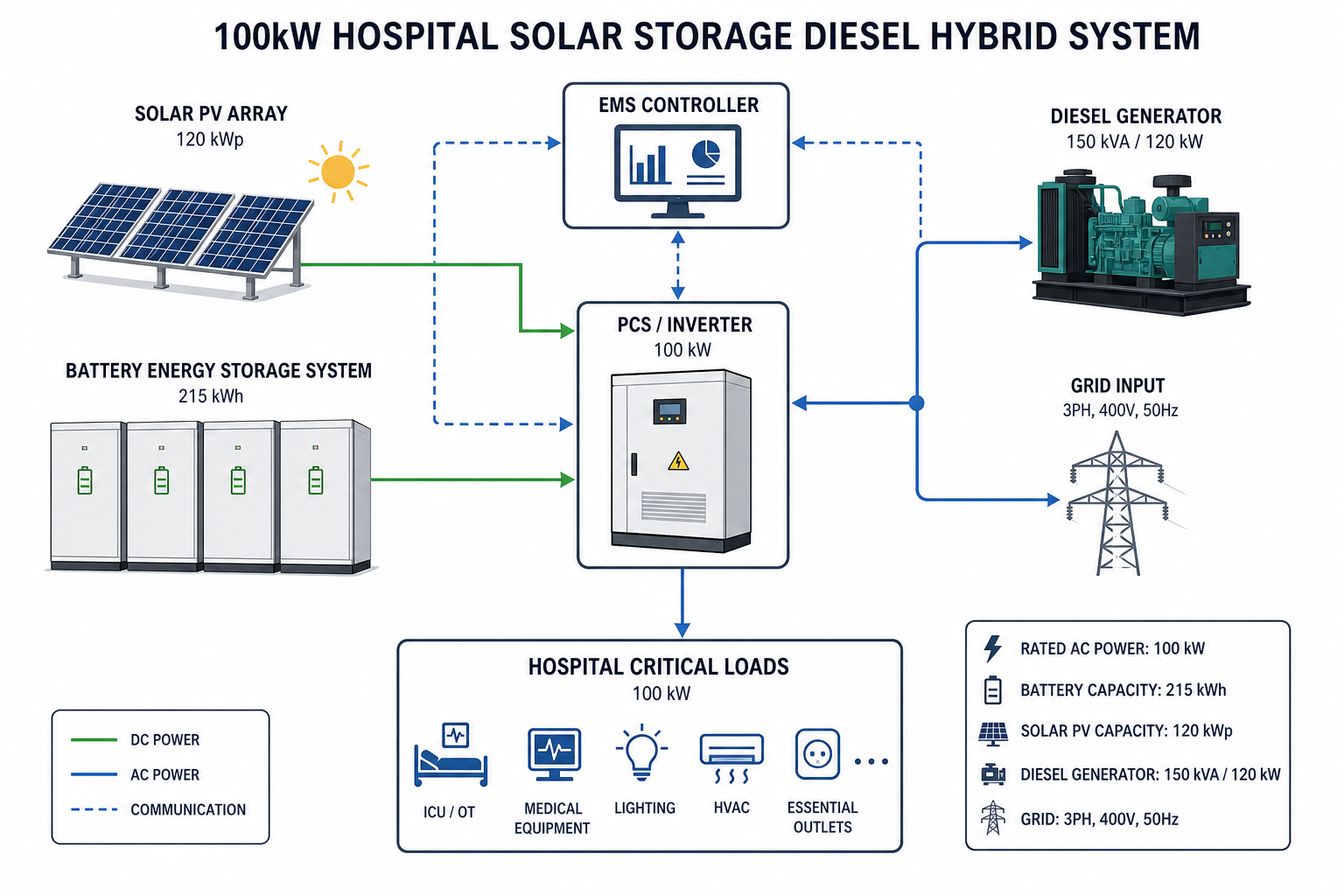
The table below shows a practical configuration logic for hospital projects. It is not a fixed design because every site needs engineering review. However, it helps buyers understand how solar, battery, inverter or PCS, EMS, and diesel generator functions should be matched.
| System Part | Typical Role in Hospital Projects | Buyer Should Confirm |
|---|---|---|
| Solar PV | Reduces daytime grid or diesel dependence and charges the battery when solar resource is available. | Roof or land area, shading, daily energy target, installation structure, and local climate conditions. |
| Battery Storage | Supports critical backup power, short outage bridging, generator runtime reduction, and power stability. | Required backup hours, usable capacity, DOD, BMS protection, expansion plan, and temperature control. |
| PCS / Inverter | Controls power conversion, load supply, charging, discharging, and grid or generator interaction. | Rated power, overload capacity, three-phase output, generator compatibility, and battery voltage range. |
| EMS | Manages system operation logic, energy priority, monitoring, alarms, and load strategy. | Operating modes, monitoring interface, remote support, generator start logic, and maintenance alerts. |
| Diesel Generator | Provides emergency backup when battery SOC is low, solar output is limited, or load is unusually high. | Existing generator rating, start signal, transfer logic, minimum loading, maintenance condition, and fuel plan. |
Solar Storage Diesel Hybrid System vs Diesel-Only Backup
Hospital buyers often compare a hybrid system with a diesel-only backup plan. Diesel-only backup can be familiar and fast to install, but it does not solve fuel cost, noise, runtime, or maintenance pressure. A solar storage diesel hybrid system requires better engineering, but it can reduce generator runtime and improve power continuity when configured correctly.
| Option | Best Fit | Main Risk | Hospital Decision Point |
|---|---|---|---|
| Diesel-only backup | Sites with very limited budget or temporary backup needs. | Fuel cost, maintenance pressure, fuel delivery risk, noise, and long runtime. | Can the hospital accept long-term generator dependence? |
| Solar and battery only | Sites with predictable load, enough solar area, and limited long-outage risk. | Oversizing risk, cloudy-day limitation, and high battery cost if backup hours are long. | Can the system support critical loads during extended low-solar periods? |
| Solar storage diesel hybrid | Hospitals needing reliable backup, diesel reduction, and controlled critical-load operation. | Requires accurate load study, control logic, and supplier engineering support. | Can the supplier design PV, battery, PCS, EMS, and generator logic as one system? |
Backup Power Configuration Steps for EPC Contractors
1. Separate Critical Loads From General Loads
The first step is to divide hospital loads into critical, important, and flexible categories. Critical loads may include emergency lighting, laboratory equipment, vaccine refrigeration, oxygen-related equipment, water pumps, communication systems, security, and selected medical devices. Meanwhile, flexible loads may include laundry, some office areas, or non-essential cooling zones.
This separation helps the EPC contractor avoid oversizing the system. It also helps the hospital owner understand which loads can be protected by battery storage and which loads should be managed by operating rules.
2. Define Backup Duration by Department
Backup duration should not be one number for the whole hospital. A vaccine refrigerator may need longer runtime than a non-critical office area. An emergency room may need continuous power, while some mechanical loads may run in scheduled periods.
For a 100kW project, a buyer may ask for two to four hours of battery backup for critical loads, then use the diesel generator for extended outages. However, this must be confirmed with the real load list and site operating plan.
3. Match Battery Capacity With Generator Strategy
A battery can reduce generator starts and handle short outages quietly. However, the diesel generator should still be included if the hospital requires emergency redundancy. The EMS can be designed to start the generator when battery SOC reaches a defined level or when load exceeds the storage system limit.
Therefore, the buyer should not only ask for battery kWh. The correct question is how the system will decide when to use solar, battery, grid, and diesel generator power.
4. Confirm Three-Phase Output and Starting Current
Hospitals may use pumps, air-conditioning units, refrigeration equipment, sterilization equipment, and other motor loads. These loads may have starting current higher than normal running current. For this reason, PCS or inverter selection must consider surge capability, three-phase balance, and load priority.
WHC Power focuses on C&I energy storage projects, so buyers can discuss these requirements through the WHC Power solutions page before final configuration.
Project Scenarios for African Hospitals
A private hospital in a city may already have grid power, but outages and voltage drops can interrupt sensitive equipment. In this case, the hybrid system may focus on backup power quality, battery bridging, and reduced generator runtime.
A district hospital in a semi-urban area may have a larger load profile and longer outages. Here, the design may require stronger solar generation, larger battery capacity, generator coordination, and a clear critical-load distribution panel.
A rural clinic or hospital extension may need a smaller but highly reliable configuration. If the project is below 100kW, it should still be treated as a commercial healthcare application, not a household system. For larger public health projects, EPC contractors can review WHC Power’s project reference section to understand how solar and storage projects are presented.
Supplier Checklist for Hospital C&I Storage Projects
Choosing a supplier for a hospital backup project requires more than product price comparison. Hospitals need stable operation, clear documentation, and long-term support. EPC contractors should use a supplier checklist before confirming a purchase order.
| Supplier Check | What to Ask | Why It Matters for Hospitals |
|---|---|---|
| System configuration support | Can the supplier review load profile, PV size, battery capacity, PCS rating, and diesel generator logic? | Hospitals need reliable power planning, not isolated component sourcing. |
| C&I product range | Does the supplier provide commercial energy storage systems suitable for 100kW-class projects? | Project buyers need scalable systems that can match hospital load growth. |
| EMS and generator control | Can the system manage solar, battery, grid, and diesel generator priority? | Poor control logic can waste diesel and reduce backup reliability. |
| Installation guidance | Will the supplier provide wiring, protection, commissioning, and operating guidance? | Hospital projects need lower commissioning risk and faster troubleshooting. |
| After-sales response | How will technical questions, alarms, maintenance, and spare parts be handled? | Backup systems must remain serviceable after delivery and installation. |
How WHC Power Supports Hospital Backup Projects
WHC Power is positioned as a Solar Commercial & Industrial Energy Storage System Specialist. For hospital projects, the company’s value is not limited to selling battery cabinets. The practical value is helping buyers think through solar generation, battery storage, PCS or inverter selection, EMS control, generator coordination, and critical-load backup requirements.
For EPC contractors, WHC Power can support project discussion around load profile, installation environment, battery capacity, and system operation logic. For hospital owners and facility owners, WHC Power can help clarify which loads should be protected by the storage system and which loads should remain under generator or manual control.
Buyers can start from the WHC Power commercial energy storage systems page to understand the product direction. For direct project discussion, buyers can contact the team through the WHC Power contact page.
In procurement discussions, the phrase diesel hybrid system should describe an integrated project design, not a loose bundle of equipment. The buyer should confirm how PV generation, storage capacity, generator start logic, EMS control, and after-sales service work together before approving the final configuration.
Conclusion
A solar storage diesel hybrid system can help African hospitals improve backup power stability, reduce diesel generator runtime, and protect critical services during outages. However, the project should be designed around hospital load priority, backup duration, solar generation, battery capacity, PCS or inverter matching, EMS logic, and generator coordination.
For 100kW-class hospital projects, buyers should avoid simple product-by-product sourcing. A better procurement process starts with a load profile, a critical-load list, backup-hour target, site conditions, and a supplier that can support system configuration.
When solar, storage, and diesel backup are designed as one C&I energy storage solution, hospitals can gain a more reliable and manageable power system for real African operating conditions.
FAQ
What is a diesel hybrid system for hospitals?
It is a commercial power system that combines solar PV, battery energy storage, PCS or inverter equipment, EMS control, and a diesel generator. The system helps hospitals reduce generator runtime while keeping diesel backup for long outages or emergency demand.
Is a 100kW system enough for a hospital?
It depends on the hospital load profile. A 100kW system may support selected critical loads in a small or medium facility, but larger hospitals may need a bigger system. Buyers should prepare a load list before sizing the system.
Why should hospitals keep a diesel generator if they install solar storage?
Hospitals often need emergency redundancy. Solar and battery storage can reduce diesel use, but the generator can still support long outages, cloudy periods, or unusually high loads.
What information should EPC contractors provide before asking for a quotation?
EPC contractors should provide load list, critical-load priority, operating hours, backup duration target, existing generator rating, available solar area, grid condition, installation location, and expected expansion plan.
Can WHC Power support hospital C&I storage configuration?
Yes. WHC Power focuses on commercial and industrial energy storage systems and can support project buyers with system configuration discussion, product selection, and commercial storage quotation preparation.
CTA
Planning a 100kW-class hospital backup power project in Africa? Send your hospital load profile, diesel generator information, backup-hour target, and installation conditions to WHC Power for C&I energy storage configuration support.
.svg)


